
1958 · Sochi
Andre Geim is born. He graduates from Phystech and defends his PhD in Chernogolovka.
Nobel-winning graphene, the Curie brothers’ tourmaline and lenses that take on blue light: one pair of glasses in numbers, prizes and readings
In brief
WHIEDA Graphene Glasses are computer glasses with a frame made of polyamide with graphene and tourmaline nano-bioceramics. Andre Geim and Konstantin Novoselov received the 2010 Nobel Prize in Physics for their experiments with graphene. In the frame, graphene picks up the warmth of your face and passes it to the tourmaline. The tourmaline responds with a charge, and a little cloud of negative air ions forms around your eyes. Meanwhile the lenses take on the screen, glare, bright light and long hours of staring at one spot. The screen day comes to an end, and your eyes are still your own in the evening, with energy left for a book, dinner and a long conversation.
Graphene is a form of carbon, that same element number 6 from Mendeleev’s periodic table, and it all starts with an ordinary pencil. Pencil lead is graphite, a stack of carbon layers: there are three million of them in a single millimetre. Each layer is a mesh of hexagons just one atom thick, rather like a honeycomb. That is graphene (Nobel Committee). The layers hold on to each other only weakly. Anyone who has written a note in pencil may well have left a tiny flake of graphene on the paper.
Physicists tried for decades to isolate a single such layer. Many believed a crystal one atom thick would simply fall apart. In 2004 in Manchester, Andre Geim and Konstantin Novoselov stuck adhesive tape to graphite and peeled it off. Then again. After ten to twenty peels, the flakes thinned down to a single atom.
The experiment was born on a “Friday evening”. That’s what Geim’s lab calls experiments done not to plan but out of pure curiosity (Science Museum, London). On one such Friday, Geim poured water into a powerful electromagnet, and the drops hung in mid-air. Later, a live frog levitated in the magnetic field. For that he received the Ig Nobel Prize in 2000, a tongue-in-cheek award for funny science. Ten years later came the Nobel. Geim is still the only person in the world with both prizes, and it’s recorded in the Guinness World Records (Wikipedia). And one of his 2001 papers lists a hamster named Tisha as co-author.
This story has a direct Russian connection: both Nobel laureates were born in Russia.
1958 · Sochi
Andre Geim is born. He graduates from Phystech and defends his PhD in Chernogolovka.
1974 · Nizhny Tagil
Konstantin Novoselov is born, also a Phystech graduate.
2004
The journal Science publishes a paper: a free-standing layer of graphene obtained for the first time.
2010
The Nobel Prize in Physics, “for groundbreaking experiments regarding the two-dimensional material graphene”. Novoselov is 36, the youngest physics laureate since 1973. (Nobel Committee)
That’s how many times stronger than steel graphene is. A one-square-metre hammock made of it would hold a cat, yet weigh about a milligram, as much as one cat’s whisker (award ceremony speech).
That’s how many times better than silver graphene conducts heat. According to the Nobel Committee, better than any known material.
That’s how thick a layer is. It’s almost transparent, yet so dense that not even helium, the smallest gas atom, can pass through it.
Ordinary computer glasses are a clear frame and a promise of “blue light protection”. You put them on, sit at the laptop, take them off, and it’s hard to say what changed. With WHIEDA, the frame does its part too. For the frame, one line from the Nobel Committee’s explanation matters most. Mix just 1% graphene into plastic, and the plastic starts to conduct electricity. Mere fractions of a per mille raise its heat resistance by 30 °C and make it mechanically stronger. The Committee dreamed of satellites, aircraft and cars made of such composites (prize explanation).
You’re holding the same principle, only on your face. PA6 is polyamide-6, a tough engineering plastic. The letter G stands for graphene. Tourmaline nano-bioceramics are blended into the same material. You can bend the frame into an arc and it springs back into shape. The arms gently adapt to both narrow and wide faces. The glasses don’t press on your temples, so you wear them all day, and they don’t languish in their case.
MaterialPlastic
Warmth of the faceStays where it touches
ChargeNo
BendingOne bad bend and it cracks
MaterialPolyamide-6, graphene, tourmaline nano-bioceramics
Warmth of the faceGraphene spreads it across the whole frame
ChargeTourmaline responds to warmth and movement
BendingBends into an arc and springs back into shape
Power supplyNot needed: no batteries, no wires
Tourmaline is a mineral with character. Heat a crystal, and an electric potential appears at its ends. This is the pyroelectric effect: Franz Aepinus proved it in 1756, and in 1824 David Brewster gave it its current name (Wikipedia). Squeeze the crystal, and the potential appears again. This is the piezoelectric effect. It was discovered in 1880 by the brothers Pierre and Jacques Curie, and one of their crystals was tourmaline (Wikipedia). Twenty-three years later Pierre Curie would receive the Nobel Prize together with Marie Curie (Nobel Committee). Both properties of the mineral were measured in a study by Michigan Technological University.
In the frame, it all happens by itself. Your face warms the temple arm, graphene instantly spreads the heat through the composite and passes it to the tourmaline, and the pyroelectric effect kicks in. You turn your head, adjust your glasses, the arm touches your skin and hair, and the piezoelectric effect kicks in. Graphene carries the charge through the frame. Free electrons settle on the oxygen and moisture molecules around your face, and the air near your eyes fills with negative air ions. The result is a wearable anion generator with no batteries, no wires and no “on” button.
Anyone who grew up in the USSR remembers the Chizhevsky chandelier: a ceiling device with needles that filled a room with negative air ions. Alexander Chizhevsky began experimenting with ionised air in 1918 and tested the chandelier in the lab in 1927 (Wikipedia). For more than twenty years he was friends with Tsiolkovsky. In 1924 he republished Tsiolkovsky’s work on rocket devices and sent it to scientists abroad. In 1939 Chizhevsky was elected honorary president of the First International Congress of Biophysics. He often paid for his experiments himself: in Kaluga he painted more than a hundred pictures and sold them.
In 1960 he published his book “Aeroionification in the National Economy”, which is kept in the Russian State Library. Air ions were already being studied in the USSR in the first half of the 20th century. The chandelier needed a wall socket and high voltage. The PA6/G frame needs nothing more than the warmth of your face.
At presentations the team holds a KY-5010PRO negative ion tester up to the glasses. The device has been travelling to meetings for three years now, winter and summer, and hundreds of readings have piled up. They measure indoors, right up against the frame, at the same distance every time. The glasses go on, the tester is brought up to the temple arm, and the numbers climb right before the audience’s eyes.
There are four numbers, each with its own conditions. The tester counts in arbitrary units, the specification in ions per cubic centimetre:
Room air: 5–10
Tester away from the glasses.
Frame on the table: about 7 000
Tester right up against the temple arm, room temperature.
Frame after wearing: up to 12 000
Same conditions, but the glasses have sat on the skin and warmed up.
Model specification: 1 000–2 200 ions per cm³
The rated anion activity of the frame material. At presentations the tester sits right at the temple arm, which is why the numbers are higher.
That’s how many times more ions the tester sees at a warmed frame than in the air of the same room: 12 000 versus 5–10.
The reading is easy to see with your own eyes: ask a consultant to hold the tester up to the temple arm.
In 2014 the Nobel Prize in Physics went to the blue LED (Nobel Committee). Red and green diodes had existed for a long time, but without blue there was no white light. Isamu Akasaki, Hiroshi Amano and Shuji Nakamura made it in the early 1990s, and the world switched to LEDs: lamps, monitors, phones. The Committee wrote that incandescent bulbs lit the 20th century, and LEDs would light the 21st.
In 2017 the Nobel Prize in Medicine went to Jeffrey Hall, Michael Rosbash and Michael Young for how our internal clock works (Nobel Committee). This clock runs sleep, hormones and body temperature around the day. It sets itself by light. The retina has special cells with the pigment melanopsin, and they respond most strongly to light at around 480 nm (Wikipedia). That’s the blue part of the spectrum.
At Harvard, researchers compared 6.5 hours of blue and green light at the same brightness. Blue suppressed melatonin, the sleep hormone, for twice as long and shifted the internal clock by 3 hours instead of one and a half. For people who spend their evenings with screens, Harvard Health recommends glasses that block blue light (Harvard Health).
WHIEDA lenses filter 380–500 nm. The International Commission on Illumination calls the 400–500 nm band short-wavelength visible light, in other words blue light (CIE). The 380–400 nm band lies on the border between violet and UVA ultraviolet. This range is felt most when you spend the whole day looking at an LED screen under bright lamps. The model’s specification lists an inorganic anti-glare coating, high light transmission and a UV filter, and you can see the difference under an ordinary UV torch. There’s no yellow haze. A designer sees her true colours, a child sees an ordinary cartoon, and the picture becomes calmer for long hours of work.
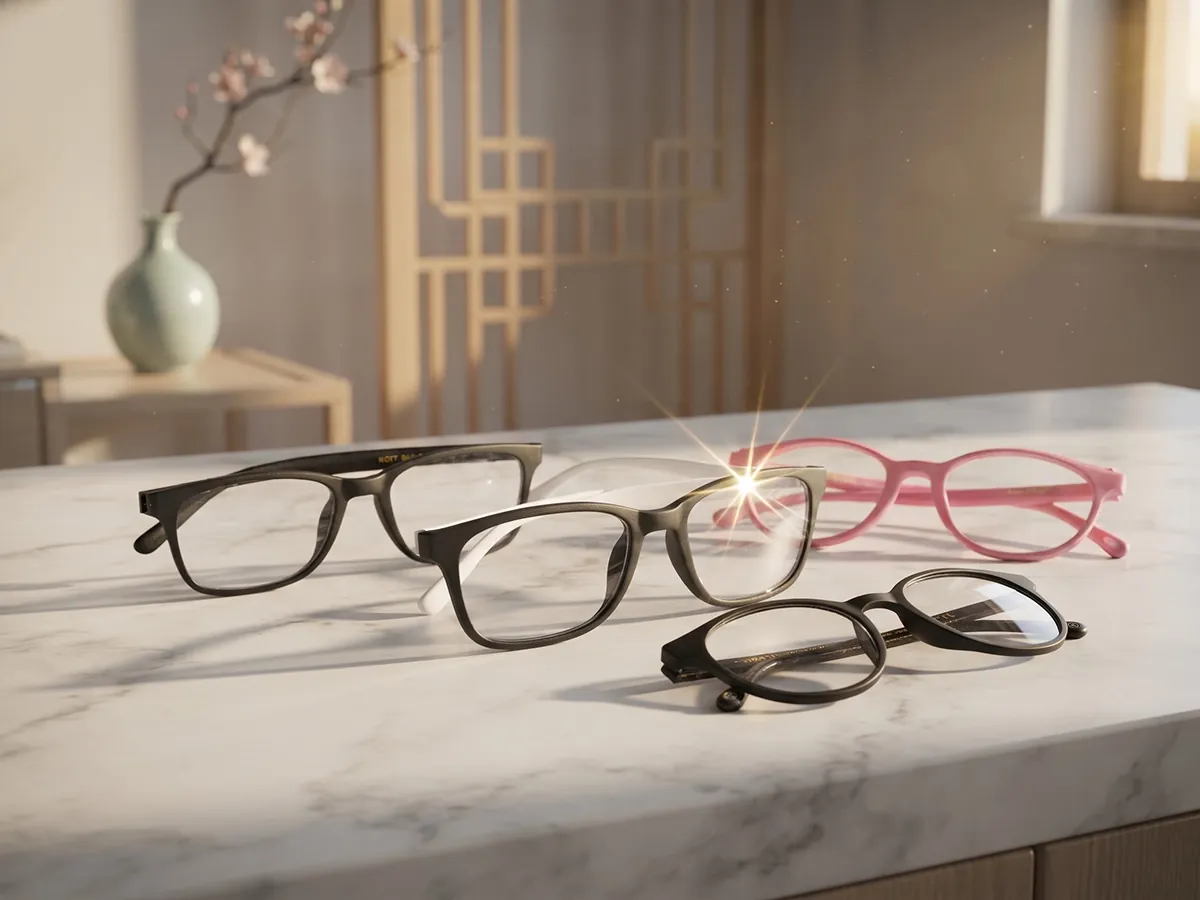
Night, oncoming headlights, dashboard glow, mirrors and wet asphalt reflecting all of it. Your gaze keeps jumping between light and dark, and your eyes tire before the driver does. Taxi drivers on our team drive night shifts in these glasses. They all say the same thing: after a long night on the road, their eyes no longer feel like they’re “popping out of their head”.
People buy the glasses for the screen, and then they end up in the family first-aid kit. Three stories from our archive: people described in their own words what it was like before and what changed after.
Mornings with cold water
Every morning the child would run to splash cold water on his face: his eyes were watering and puffy. He wore the graphene glasses for two hours, and by evening, the family writes, the puffiness had almost gone. The parent sent a photo.
Anastasia and the night-time snoring
Anastasia wrote to us about a child who had lived with a chronic runny nose for three years and snored at night. After the very first day in the glasses, she heard the child’s nose breathing freely, and the night passed peacefully.
The first spring without tissues
For decades, a grown man greeted the blossom season with pills and a packet of tissues. He started wearing the glasses every day and wrote to us: for the first time, spring went by without a runny nose and tears.
Screens from morning till night
IT, accounting, sales, design, studies, paperwork. You can’t cut down your screen time, but you can spare your eyes by evening.
Squinting by evening
You rub your eyes and squint even at ordinary lamplight.
Behind the wheel
Night shifts, long highways, oncoming headlights.
For a child with a phone
Their very own children’s pair with black or pink arms, for lessons, cartoons and games.
For those who gave up on yellow glasses
Clear lenses, true colours and a light frame instead of a bulky gadget.

Put them on in the morning and forget about them. The glasses have no batteries, no charging and no buttons: their “battery” is the warmth of your face.
Morning
Put them on before you reach for your laptop or phone. The frame warms up from your skin all by itself.
All day
Work, studies, reading on your phone, an evening series. No need to take them off every half hour.
Behind the wheel
Colours stay true, so the glasses are good for the road and for night shifts too.
Evening
Into the case. Wipe with a soft cloth, like any glasses.
The manufacturer advises caution in cases of hyperthyroidism, bleeding in the fundus of the eye, after eye surgery and with epilepsy: in these cases it’s worth consulting a doctor before buying. The glasses do not replace prescription lenses or a consultation with an ophthalmologist; vision correction is chosen separately. In case of pain, injury, a sudden deterioration in vision, or increasing swelling, weakness or difficulty breathing, seek emergency medical help.
РОСС RU.33039.ИЛ05ОС.00615Certificate of conformity
“High-tech glasses”, HEALTH PRIORITY marking, serial production. Issued under the NOVA voluntary certification system on the basis of test report IL05OS-021523 dated 19 June 2025, valid until 18 June 2028. Open PDF ↗
Nobel · 2010Graphene
The Physics Prize to Andre Geim and Konstantin Novoselov. Prize page ↗
Michigan TechTourmaline
The mineral’s pyroelectric and piezoelectric response. Open the study ↗
RSL · 1960Chizhevsky
“Aeroionification in the National Economy”. Library record ↗
Google PatentsGraphene and polyamide
Patents for graphene–polyamide composites are granted all over the world. Open the search ↗
CIEBlue light
Definition of the short-wavelength visible range. Open the term ↗
Who’s who: the glasses are made by the Tianjin company Tianjin Fohoway Technology Development, and in Russia and the CIS they are sold by WHIEDA.
Do the glasses need charging?
No. The frame works from the warmth of your face and ordinary head movements while you’re wearing the glasses. No batteries, no wires, no socket.
Can I wear them while driving?
Yes, the road is one of the main uses. The anti-glare coating takes on oncoming headlights, while the colours of traffic lights and road signs stay true.
Are there children’s ones?
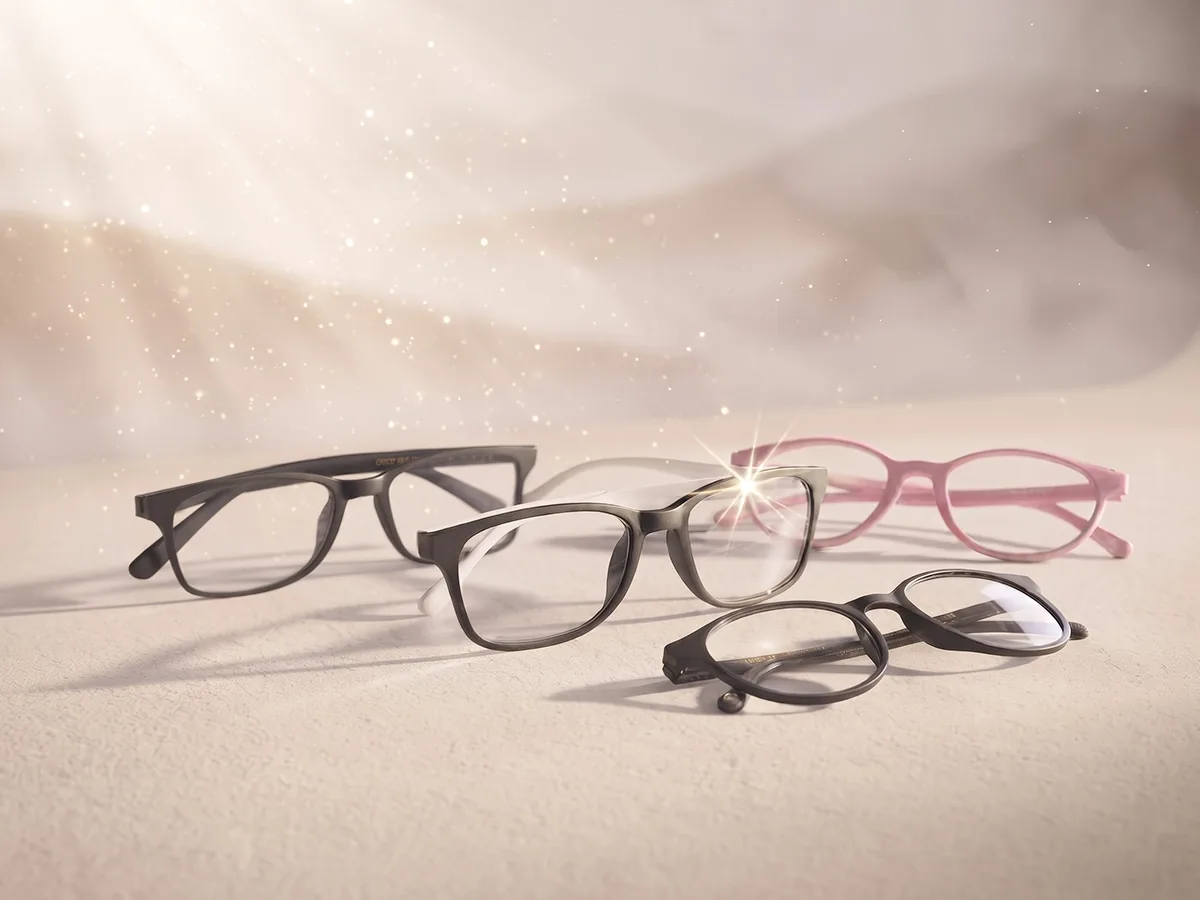
Yes. Adult frames come with white and black arms, children’s ones with black and pink. You choose the option you need on the product card.
How are they better than cheap “anti-blue” glasses?
Cheap ones are usually yellow: they cut out blue entirely, and the picture swims. WHIEDA lenses are clear, with a precise 380–500 nm band and a UV filter. And the frame bends into an arc and gathers an anion layer around your face all by itself.
Graphene from Geim’s Friday experiment, the Curie brothers’ tourmaline, the idea behind Chizhevsky’s chandelier and lenses that take on blue light, all in one light pair.
A long day in front of a screen and on the road feels noticeably easier with them. The glasses cost 5 500 ₽. Wear them every day for a year, and that’s about 15 ₽ a day. The product card shows all four frames, adult and children’s, and what’s in stock.